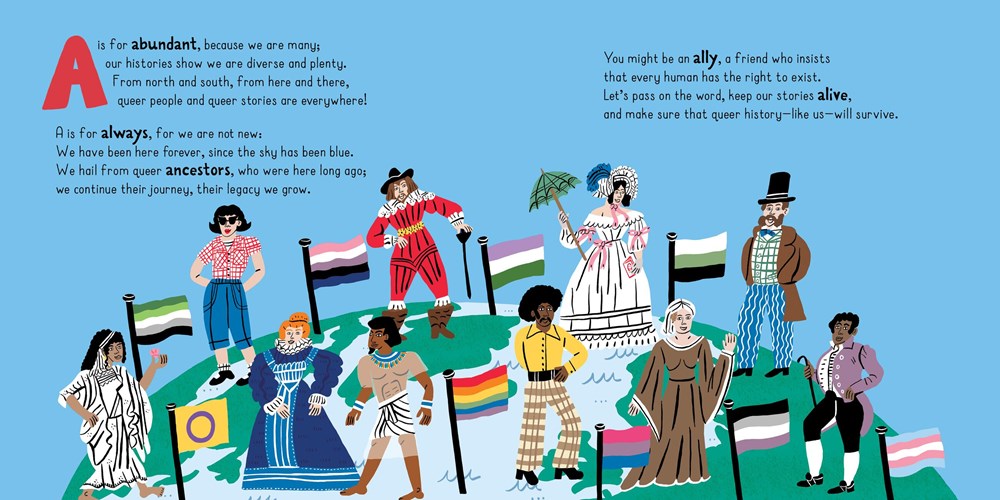
The ABCs of Queer History by Dr. Seema Yasmine and Lucy Kirk is a vibrant introduction to LGBTQ+ history for young readers. In this interview, Dr. Yasmin discusses her inspiration, the book’s creation, and the importance of teaching queer history through engaging and inclusive storytelling. Join us to learn more about her mission to educate and celebrate diversity one letter at a time.
Dr. Seema Yasmin is an Emmy Award-winning journalist, medical doctor, and professor. She is director of the Stanford Health Communication Initiative, clinical assistant professor in Stanford University’s Department of Medicine, and visiting professor at the Anderson School of Management at UCLA where she teaches crisis management and
communications. Yasmin was a finalist for the Pulitzer Prize in breaking news in 2017 with a team from The Dallas Morning News, and she is the recipient of two awards from the Pulitzer Center on Crisis Reporting. Her reporting appears in Rolling Stone, The New York Times, WIRED, Scientific American, and other outlets. She is a medical analyst for CNN and a correspondent for Conde Nast Entertainment. Her books paint vivid pictures about ourselves and how we interact with the world around us and include What the Fact?!: Finding the Truth in All the Noise, Muslim Women are Everything, the poetry collection If God Is a Virus and more.

How did The ABCs of Queer History come about? Since it follows The ABCs of Black History by Rio Cortez and Lauren Semmer, I’m curious—did you approach the publisher with the idea, or did they have you in mind for the project?
The ABCs of Queer History is the second title in the ABCs series and the editors were looking for a writer, preferably a queer poet, I believe, and so I drafted a manuscript that they loved! Of course that original manuscript went through considerable changes to finally arrive at the version you see in print.
The ABCs of Queer History covers so many significant topics, from the Stonewall Riots to influential figures like Audre Lorde and Harvey Milk. How did you decide which people and events to include? Were there any lesser-known stories that you were especially excited to share?
It’s thrilling to rewrite queer icons back into the history books! So many have been erased over time to the point that many of us don’t know that the iconic 1963 March on Washington for Jobs and Freedom wouldn’t have happened without Bayard Rustin. It was also exciting writing about the lies of Charlie Parkhurst and Alan Hart, both born in the 1800s and would have been assigned female at birth, but they chose to live as men. They were brilliant in their own ways and easily do away with this idea that challenging gender constructs is a 2020’s thing. I’ve even had some queer people tell me that “trans is new” and it clearly isn’t a 21st century concept! Humans have been playing about with gender for as long as we’ve been on this planet.

Title: The ABCs of Queer History
Author: Dr. Seema Yasmine
Illustrator: Lucy Kirk
Publish Date: Apr 30, 2024
Publisher: Workman Publishing Company
Every letter in The ABCs of Queer History represents a different part of queer history, like Allies, Ancestors, Hope, Knowledge, and Love. How did you tackle the challenge of summarizing these diverse and complex themes into short, engaging verses for kids?
Writing children’s books can be challenging because of the economy of language. I came to The ABCs of Queer History soon after writing What the Fact?!, a YA non-fiction book that’s around 80,000 words long, so telling the stories of Audre Lorde, Josephine Baker, Pat Parker and James Baldwin in just a few words required deep thought about what exactly I wanted to convey in the main text. (I had more space to elaborate in the back matter.) I focused on these legendary people’s contributions to society but also how they made people feel, whether they succeeded at making people dance and sing or read a page and see themselves represented in literature.
You have a unique perspective with your background as a medical doctor and an Emmy Award-winning journalist. How does your medical experience shape your storytelling, particularly on topics like LGBTQ+ health and wellness?
Medicine is typically a staunchly homophobic space, a system used to police queer people and people of color and one that works hard to maintain the status quo. (That’s why it’s even more important to highlight the likes of Dr. Alan Hart who pioneered the use of x-rays to diagnose tuberculosis.) The roles I’ve played, including hospital doctor, disease detective, newspaper reporter, cable news analyst, professor and author remind me of the many perspectives out there and the myriad ways you can approach a story.
How have recent book challenges and bans influenced how you write and promote your work? Have these experiences changed your creative process at all?
I think about Toni Morrison when she said “The function, the very serious function of racism is distraction. It keeps you from doing your work. It keeps you explaining, over and over again, your reason for being. Somebody says you have no language and you spend twenty years proving that you do.” And I feel this pertains to book bans and censorship as well. Queer, black and brown writers are tired of our books being banned, of the threat of censorship, of teachers and librarians telling us they’re scared to teach our stories or include our books on their shelves. And yet, here we are, writing all the stories we choose to write. As I say in a recent op-ed: “As a disinformation scholar, I know how that stories are critical stories are to combatting polarization. Books are potent engines of empathy and sentences hold the power to disrupt and dismantle the status quo. That’s why book bans are flourishing, each attempt at censorship a reminder of the power of language. That’s why I continue to write. Not in spite of the bans, but because of them.”
Can you share any inspirational stories of how “The ABCs of Queer History” has positively impacted readers?
Trans kids feeling angst about changing their pronouns multiple times have found comfort in F is for fluid, which reminds us that we can choose who we want to be whenever we want to be. I’ve also heard from adults that they’ve bought copies of The ABCs of Queer History for nieces and nephews, but also for themselves because it’s the book they wish they’d had when they were a kid.
What message do you hope readers, both young and old, will take away from “The ABCs of Queer History”?
That queerness is not one thing; there is no narrow definition of queerness or what that should look it. There is diversity upon diversity. And that queer people have stoooories, for days! Our contributions to society are vast and we often haven’t heard of these stories or legendary contributions because people in power have tried to erase us from the history book and keep our iconic status silent.
What’s next on your horizon? Are you planning more projects that explore LGBTQ+ themes in children’s literature or build on what you’ve done with “The ABCs of Queer History”?
Everything I write is through the lens of a queer, Muslim woman. My debut YA novel, Unbecoming, is out in July 2024 and features a queer Muslim teen on the cover. I launch my middle grade series next year with Simon and Schuster called Muslim Mavericks, each chapter book exploring the life of a brilliant comedian, scientist, actor or astronaut. I’m working on my second YA novel which is spooky and yes, also Muslim and queer. And I’m so excited about my illustrated and very spooky story collection, Djinnology, which will be out this Halloween!
To learn more about Seema and her work, be sure to visit her online at her website seemayasmin.com, on Instagram @drseemayasmine, and Twitter @DoctorYasmin.
 Rainbow Reads For Kids